
I’m in the process of grading the first stack of papers from a composition class. Recently the news cycle has covered the issue of cheating in college. Such stories generally focus on a specific form of plagiarism: fully copied papers that exemplify the worst of intentions. In reality, there are many kinds of plagiarism, and I like to draw a distinction between misdemeanor and felony plagiarism. The latter should be obvious enough. However, there are many instances when students are trying to follow the rules but lack knowledge to do so. For this reason, I treat the first paper assignment differently than I do others. Some students are not sure what does not qualify as common knowledge (which is tricky because it can vary based on one’s expertise in a field). Some students correctly credit sources in a paper but fail to understand that reference sources also need to be credited. Some students are not sure how to paraphrase material.
I often bounce papers back to students in such cases. I give them two grades: the grade they will receive if they don’t rectify the issue and the grade they will receive if they do correctly fix the issue. Yes, some students are careless, but others were not properly taught these rules in high school. (I have heard many horror stories about high school teachers who pass students for showing up to class.)
Here is an example of a paper to which I responded today:
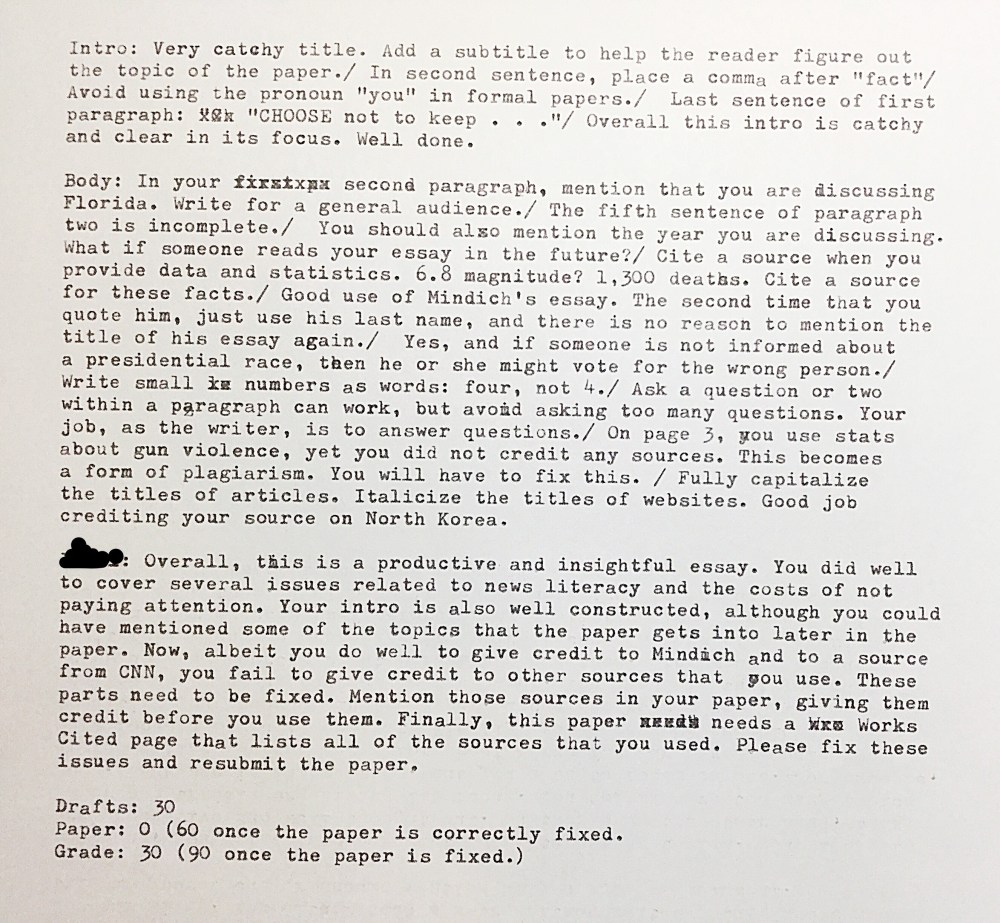
Overall, the student is a strong writer, but she has stumbled into misdemeanor plagiarism. Today issues have become compounded by the lazy habits and unprofessional practices that come with social media and second-rate websites. More than this, many leaders in the professional world break these rules without facing repercussions. I am glad I grew up in a world free of such tech. I never considered cheating on schoolwork, but cheating would have required too much effort anyway.
My job is to give students the tools that will make them the professional role models of the future. In many respects, my job is to also instill in students a work ethic and a sense of moral integrity. After all, that’s what employers are looking for in future employees.
 The Untimely Typewriter:Daily Writings Against the Tides of Distraction