Sounds interesting even though in my limited knowledge I’m only partly familiar with James Joyce, and a bit of Irish mythology. We had plenty of Irish in town, mostly coal miners, but they were several generations removed from some of my friends of the 90s who recently moved to town from Ireland. Very different outlooks on the myths and legends of the Emerald Isle.
From what I understand, the Virginias and Carolinas had a lot of the pre-famine immigrants—mostly Presbyterians, I think—as opposed to Boston, New York, and Chicago, urban destinations for famine and post-famine immigrants.
I have Northern Irish on one side of the family and Catholic Irish on the other. Only in America.
Hm. Well immigrants go where the jobs are—mining, building rails, working factories. The Scots Irish were the earlier Protestants though. They looked down on the famine immigrants, most of whom were Catholic and many of whom spoke Gaelic. Then came the recruiters for the Union Army, albeit some immigrants joined the Confederates, not wanting to compete for jobs with freed slaves. Conversely, Irish Catholic political prisoners/labor rebelled alongside slaves in Jamaica (Jamaican event coming up at my college).
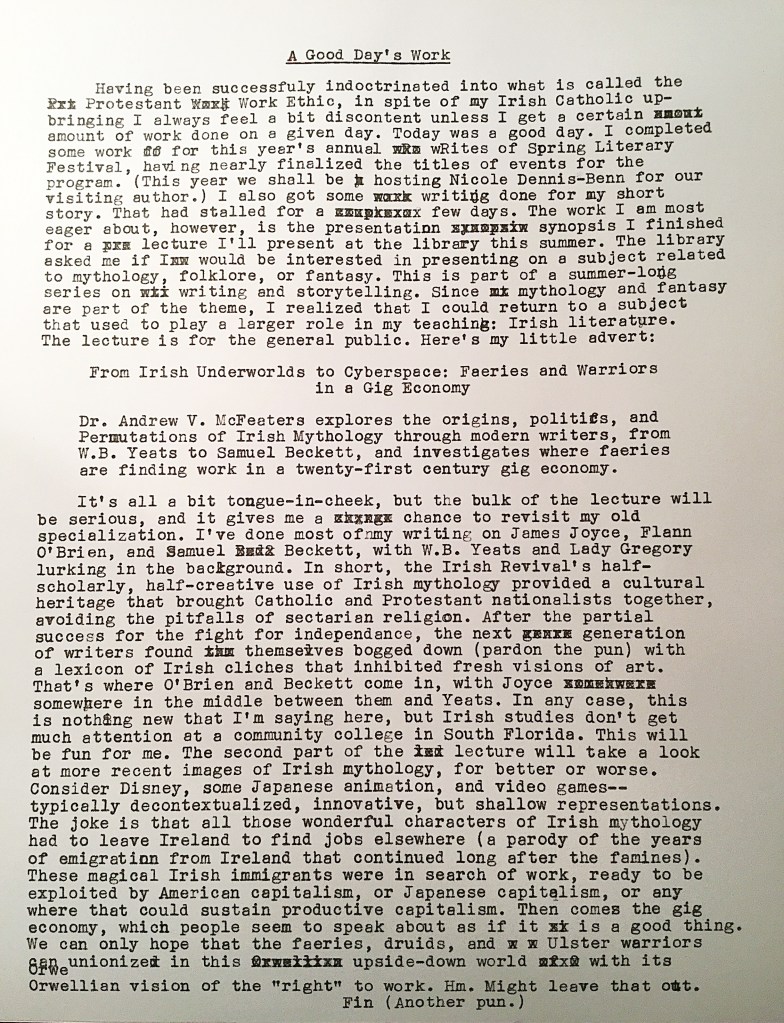
Neil Gaiman’s “American Gods” (the book, not the TV series), which he wrote shortly after arriving from London to live in the American Midwest, is sly and brilliant in analogizing the immigrant experience, as the old ethnic gods and spirits follow their people to the new world and find themselves cast adrift. I found the story of the leprechaun—not the cute leprechaun of cartoons, but a dangerous trickster figure with all the charisma and self-doubt of the Irish people—was particularly moving.
The American Protestant ethic would have a lot on its conscience, if it had one, beginning with the disenchantment of the world and the reduction of human lives to their value in the economy. I hope Northern Ireland and Scotland can recover their Celtic roots and that the Brexit fiasco encourages them to move forward with their distinct identities.
You bring up one more book I have yet to read. Sounds like Gaiman’s representation of the leprechaun is more faithful. (Maybe I can read it over a break.) They were fairies (sidhe), and the fairies reflected the complexities, fears, and desires of human psychology. They were good, they were bad, they were gray rather than black and white. Disney ruined all of that. Gaiman’s character sounds like the Pooka.
Sounds like a great talk. I would attend!
Speaking of things Irish, yesterday I met a typewriter lover who is working on a book based on his Irish grandfather’s story of joining the Nazis during WWII just so he could kill Brits. Now that’s dedicated bloodthirstiness. The British responded by drafting Irishmen to fight on their side, and sending them into battles where they knew these “Wild Geese” would be present.
WWII was really complicated in the Emergency State. De Valera was holding out on Churchill, who wanted access to Irish ports for his navy. A lot of the Irish were unhappy with Ireland’s neutrality, and they joined the British army. There were some Irish talking to the Nazis (as the British did early on). Certainly, sharing an enemy doesn’t play out well in this case. Nazis are Nazis. This wasn’t WWI.

 The Untimely Typewriter:Daily Writings Against the Tides of Distraction
Sounds interesting even though in my limited knowledge I’m only partly familiar with James Joyce, and a bit of Irish mythology. We had plenty of Irish in town, mostly coal miners, but they were several generations removed from some of my friends of the 90s who recently moved to town from Ireland. Very different outlooks on the myths and legends of the Emerald Isle.
LikeLiked by 1 person
From what I understand, the Virginias and Carolinas had a lot of the pre-famine immigrants—mostly Presbyterians, I think—as opposed to Boston, New York, and Chicago, urban destinations for famine and post-famine immigrants.
I have Northern Irish on one side of the family and Catholic Irish on the other. Only in America.
LikeLike
We had mostly Irish Catholics in our area–Anthracite country. I don’t know about the huge Bituminous areas that covers most of the USA.
LikeLiked by 1 person
Hm. Well immigrants go where the jobs are—mining, building rails, working factories. The Scots Irish were the earlier Protestants though. They looked down on the famine immigrants, most of whom were Catholic and many of whom spoke Gaelic. Then came the recruiters for the Union Army, albeit some immigrants joined the Confederates, not wanting to compete for jobs with freed slaves. Conversely, Irish Catholic political prisoners/labor rebelled alongside slaves in Jamaica (Jamaican event coming up at my college).
LikeLike
Speaking of which, this Brexit outcome is a doozy for Northern Ireland. Scotland is miffed, too.
LikeLike
Neil Gaiman’s “American Gods” (the book, not the TV series), which he wrote shortly after arriving from London to live in the American Midwest, is sly and brilliant in analogizing the immigrant experience, as the old ethnic gods and spirits follow their people to the new world and find themselves cast adrift. I found the story of the leprechaun—not the cute leprechaun of cartoons, but a dangerous trickster figure with all the charisma and self-doubt of the Irish people—was particularly moving.
The American Protestant ethic would have a lot on its conscience, if it had one, beginning with the disenchantment of the world and the reduction of human lives to their value in the economy. I hope Northern Ireland and Scotland can recover their Celtic roots and that the Brexit fiasco encourages them to move forward with their distinct identities.
LikeLiked by 1 person
I agree on all counts (your second paragraph).
You bring up one more book I have yet to read. Sounds like Gaiman’s representation of the leprechaun is more faithful. (Maybe I can read it over a break.) They were fairies (sidhe), and the fairies reflected the complexities, fears, and desires of human psychology. They were good, they were bad, they were gray rather than black and white. Disney ruined all of that. Gaiman’s character sounds like the Pooka.
LikeLike
Sounds like a great talk. I would attend!
Speaking of things Irish, yesterday I met a typewriter lover who is working on a book based on his Irish grandfather’s story of joining the Nazis during WWII just so he could kill Brits. Now that’s dedicated bloodthirstiness. The British responded by drafting Irishmen to fight on their side, and sending them into battles where they knew these “Wild Geese” would be present.
LikeLiked by 1 person
WWII was really complicated in the Emergency State. De Valera was holding out on Churchill, who wanted access to Irish ports for his navy. A lot of the Irish were unhappy with Ireland’s neutrality, and they joined the British army. There were some Irish talking to the Nazis (as the British did early on). Certainly, sharing an enemy doesn’t play out well in this case. Nazis are Nazis. This wasn’t WWI.
LikeLike