
I am an educator for selfish reasons. I need to be around ideas and I need to know where the world is headed. My students teach me as much as I teach them. I teach composition and literature courses at the community-college level in New Mexico, which means that my students come from every walk of life. This keeps me grounded in reality.
My philosophy on education is the same as my philosophy on life: quality requires effort and versatility leads to growth. We are more than our jobs, and we should cultivate as many interests as possible. America’s education system, by and large, has got it wrong, and there are many reasons for this. Specialization is a necessity but versatility better ensures success and happiness. A curious mind, making connections between seemingly disparate subjects, is a thriving mind.
I’m a big believer in trying to understand how the brain works. Technology evolves but the human brain has remained the same for a very long time. This is why, to be innovative, we should adopt the best combination of technologies that best channels how human beings work. New tech is the solution sometimes; old tech, like a pencil, notepad, book, or typewriter, is the solution other times. I say this as a person who is open to, and adept at using, new tech. I could cite studies and articles that support the value of handwritten notes or non-digital reading, but I leave it up to the reader to research that on his or her own. Research does the convincing.
The Internet and smart tech have been the harbinger of much progress, but moderation is essential to living the good life. It’s important to unplug. Use tech but don’t let tech use you. Aside from all of the psychological and neurological problems that have resulted from smart-phone dependency, my chief criticism has to do with how we overvalue convenience. 
Convenience is ideal in many situations, but it also leads to a lack of reflection, appreciation, and quality. There are times when inconvenience is the solution: for craftsmanship, for deep-living, for personal growth, for critical and creative thinking, and for developing meaningful relationships. In other words, stop to smell the roses. Write about the roses. Paint a picture of the roses. There’s no need to post a selfie of yourself with the roses. What, after all, is the core of your experience of the roses and what will constitute your memory of them?
This is where analog choices have value. We can argue all day about whether an LP sounds better or worse than a high-quality mp3. What’s important to consider, however, is how the tech interfaces  with habits and everyday ritual. Does one listening experience better resist the channel-switching of a distracted mind, thus ensuring a greater appreciation for the music? Apply this recipe to everything under the sun. Bicycles and hiking boots cultivate an appreciation for nature. Taking the stairs instead of the elevator is good exercise. Slow-cooked meals taste better and are healthier than fast food. A book, with its physical uniqueness and tangible pages, leads to deeper reflection and memory-formation than the homogeneous and ubiquitous screen. The inconvenience of the book is what makes the ideas or stories in the book more memorable, and depth and variety of memories lead to more complex and innovative cognition. In other words, knowing how to look up a word on Google is not the same as understanding and retaining the meaning of that word.
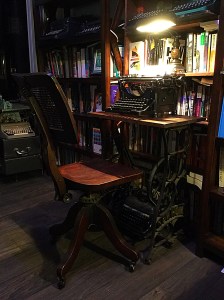
This blog is my playground. I permit myself the joys of making typos. I am here to explore ideas and to write for the sake of writing. A manual typewriter is an honest machine. There are no image filters. There is no delete button. Creativity is a messy and authentic process, and taking a wrong turn uncovers a new path. It’s the work of work. My professional publications reside elsewhere. Here I explore fiction, poetry, and essay. I occasionally wax political, because I don’t think the personal and the political can be separated. That said, regardless of my views, I respect the views of others. No one person has all of the answers, and everyone deserves respect. It’s been my experience that blogging, unlike other forms of social media, typically inspires civil, thoughtful exchanges. Cheers.
 The Untimely Typewriter:Daily Writings Against the Tides of Distraction