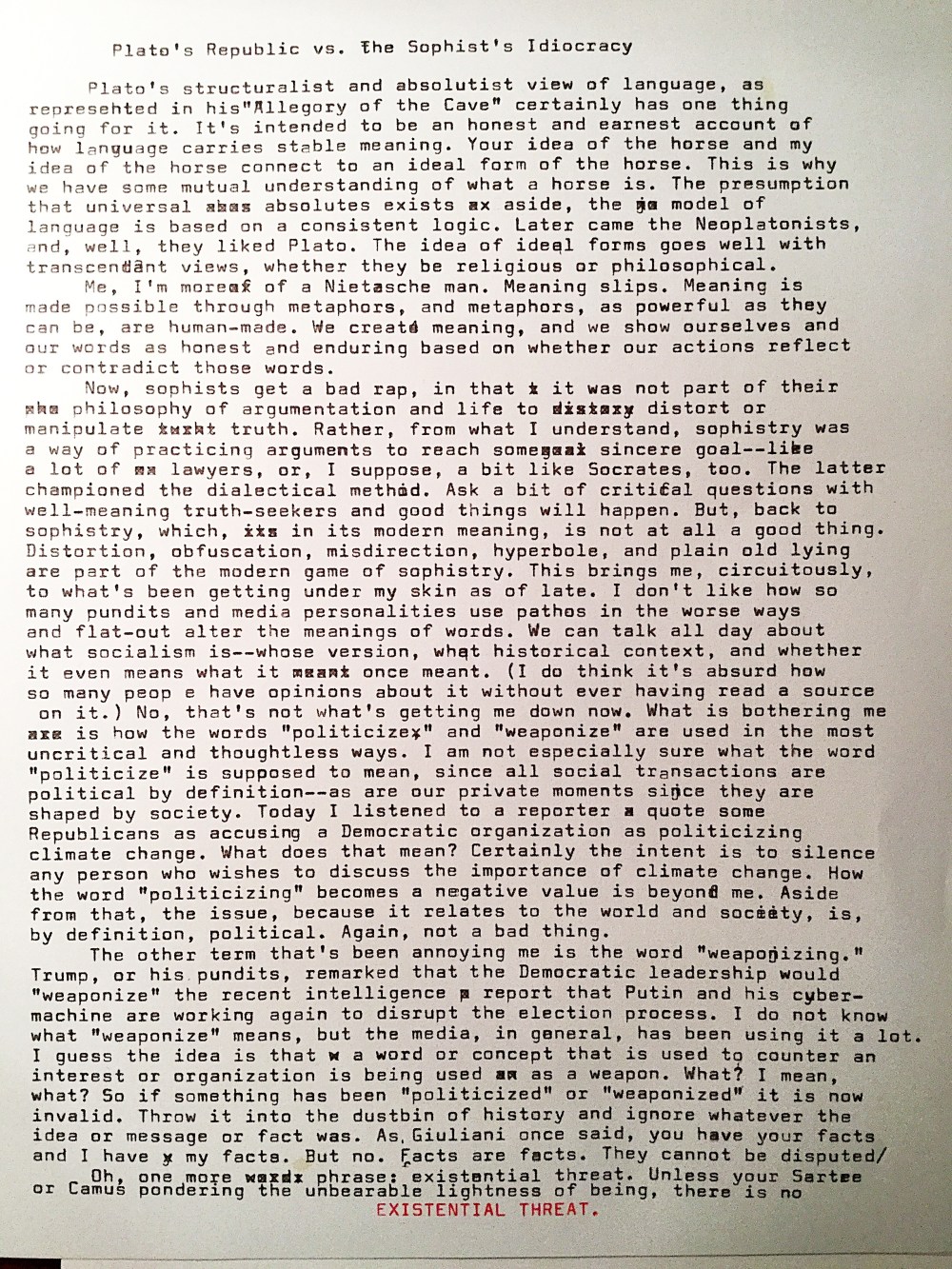
I too have noticed the phrase “existential threat” being thrown around a lot recently. People seem to be worried a lot about survival, without worrying about who they are and what their existence means …
I’d say that Plato had a considerably more nuanced view of language than you say. See “Cratylus” for an amusing and satirical view of etymology. I think Plato (or Plato’s Socrates) would argue that we often use language in ambiguous and imperfect ways; we can try to be more clear and precise, and reach the clarity of the forms, but this is an ideal rather than an achievement. Also, if we ever do come to know the forms, we will still stumble and fail to understand concrete life when we “return to the cave.”
As for the sophists, they did have a reputation for “making the weaker argument the stronger” and making the unjust seem just. I don’t think it was totally undeserved. They made money by training people to make any position whatsoever persuasive.
Alas, this is what happens when I pull from a philosophy minor from years ago. I fear my synopses have become oversimplified sound bytes. Now, am I right is saying that the Sophists, like the Epicureans, etc, were also striving to discover the”good” life? Or were they purely about rhetoric?
The sophists weren’t a school that subscribed to a set of doctrines, like the Epicureans, so it’s a bit hard to generalize about them. To judge from their representations in Plato, they did have a lot of interest in debating ethical and political questions, but they may have tended to assume that, ultimately, the good life is the life of power, influence, and pleasure. One very dramatic portrayal of a sophist is Thrasymachus, in Book I of the Republic; for him, might makes right, and the best life is the life of a tyrant. It’s hard to judge whether this a fair portrayal, of course. We only have a few snippets of words by sophists themselves, as quoted by other writers. Many people today do appreciate the sophists for their argumentative skill and for their realism, as some see it.
One thing is for sure: I’ll have to go over my notes before teaching my humanities course this semester. It’s a challenge covering 12,000 years in six weeks, but I do want to do justice to Greek philosophy. My overall emphasis celebrates their ability to make wholistic connections between what are now compartmentalized specializations.

 The Untimely Typewriter:Daily Writings Against the Tides of Distraction
I too have noticed the phrase “existential threat” being thrown around a lot recently. People seem to be worried a lot about survival, without worrying about who they are and what their existence means …
I’d say that Plato had a considerably more nuanced view of language than you say. See “Cratylus” for an amusing and satirical view of etymology. I think Plato (or Plato’s Socrates) would argue that we often use language in ambiguous and imperfect ways; we can try to be more clear and precise, and reach the clarity of the forms, but this is an ideal rather than an achievement. Also, if we ever do come to know the forms, we will still stumble and fail to understand concrete life when we “return to the cave.”
As for the sophists, they did have a reputation for “making the weaker argument the stronger” and making the unjust seem just. I don’t think it was totally undeserved. They made money by training people to make any position whatsoever persuasive.
LikeLiked by 2 people
Alas, this is what happens when I pull from a philosophy minor from years ago. I fear my synopses have become oversimplified sound bytes. Now, am I right is saying that the Sophists, like the Epicureans, etc, were also striving to discover the”good” life? Or were they purely about rhetoric?
LikeLike
The sophists weren’t a school that subscribed to a set of doctrines, like the Epicureans, so it’s a bit hard to generalize about them. To judge from their representations in Plato, they did have a lot of interest in debating ethical and political questions, but they may have tended to assume that, ultimately, the good life is the life of power, influence, and pleasure. One very dramatic portrayal of a sophist is Thrasymachus, in Book I of the Republic; for him, might makes right, and the best life is the life of a tyrant. It’s hard to judge whether this a fair portrayal, of course. We only have a few snippets of words by sophists themselves, as quoted by other writers. Many people today do appreciate the sophists for their argumentative skill and for their realism, as some see it.
LikeLiked by 1 person
One thing is for sure: I’ll have to go over my notes before teaching my humanities course this semester. It’s a challenge covering 12,000 years in six weeks, but I do want to do justice to Greek philosophy. My overall emphasis celebrates their ability to make wholistic connections between what are now compartmentalized specializations.
LikeLike