This is a nice piece. The weather is fine here, too. A little girl down the street has a birthday today—she’s three, I think—and her parents organized a bicycle “parade” consisting of just the family, with signs and streamers. Somehow they got on the local news to specify the time (noon) and the route, so their neighbors, including us, could stand outside our houses and wish Willow a happy birthday. So we did that.
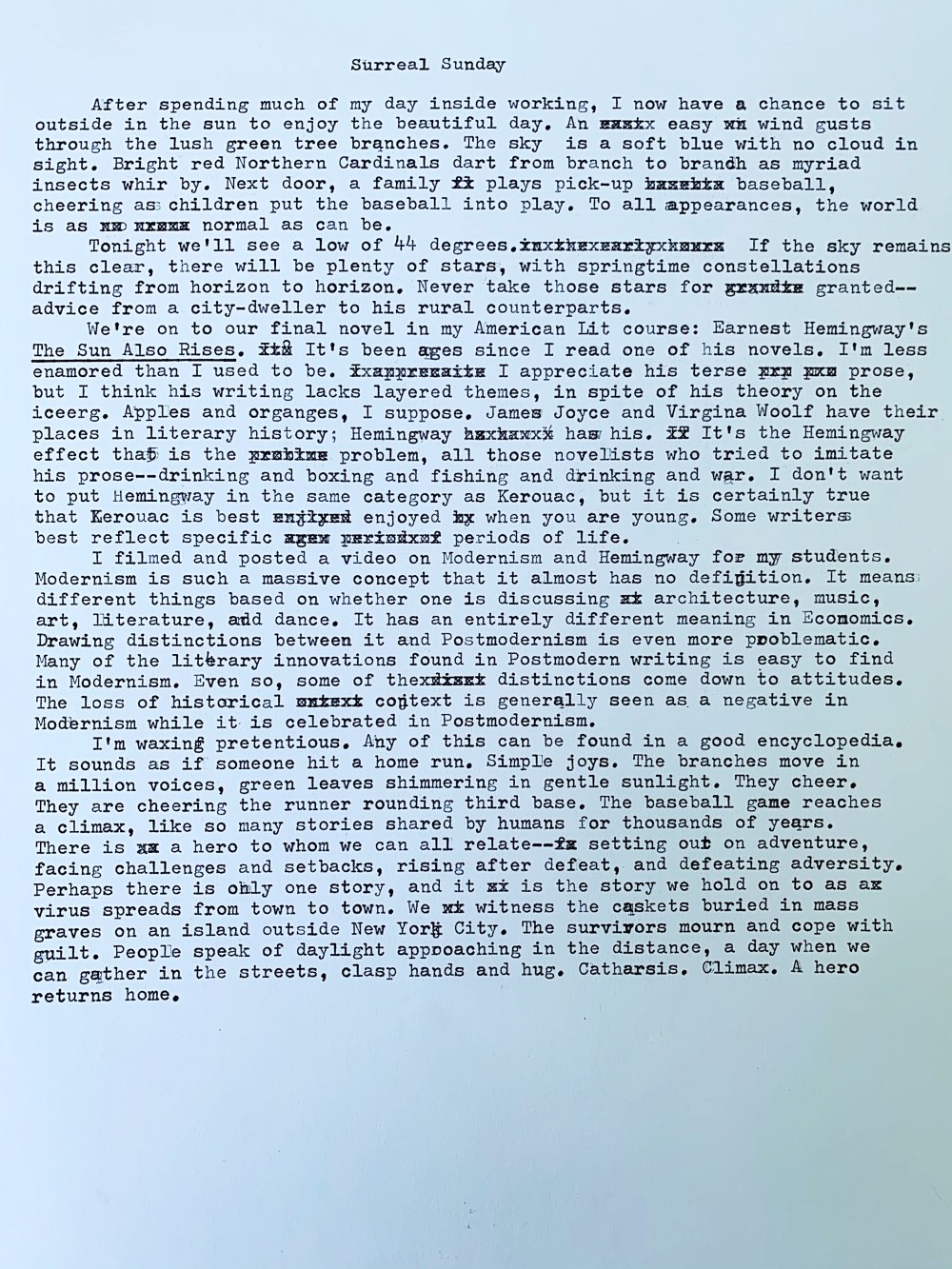
For me one difference between modernism and postmodernism (aside from the different relationships to historical context, which you rightly note) is that modernism has soul. It’s a wounded soul, throwing all kinds of beautiful babies out with the bathwater of the world wars, but it’s sincere and, correctly or incorrectly, bent on repair. Postmodernism has verve, playfulness, and sometimes even wit, but after the failure of modernism its response is to stop trying and to adopt an attitude of irony, which is death to the sincerity that soulful art requires.
Regarding Hemingway, I heard somewhere that his genius is in the short story and not in the novel. So I got a hold of his complete stories, and the very first one in the book (“The Short Happy Life of Francis Macomber”) is one of the very best stories I have ever read. It’s not a nice story—the truths it reveals about people are not polite and certainly not in fashion to acknowledge—but it’s a master class in how to tell one. As far as I’m concerned it’s written in fire.
It’s been a while since I’ve read any Hemingway stories other than “Hills Like White Elephants,” which I use to illustrate writing dialogue.
I’ve never been completely on board with the idea that irony fits pomo, since irony must recognize the original intent of what is being twisted, and that means some historical context remains. Beyond that, Modernist works produce the best irony. I see how pomo fits pastiche, and pastiche is emptied of original context; but that’s what the Dadaists did, and that’s way before any one spoke of pomo. I’m not sure pomo really exist separately from Modernism.
Maybe irony is the wrong word. In my experience, postmodernism seems to hold itself at an emotional reserve, a distancing mechanism that irony shares. (I’m thinking more of the arts than of architecture.) But I’d also respond that irony is often attempted by those who don’t understand what they’re sending up. As for postmodernism existing separately from modernism, I don’t think it does in our world, but I can imagine a world in which it does.
Those are really good points. I think pastiche is a tool for the Modernist, but it isn’t the framework. Pastiche becomes the framework for the Postmodernist. At least that’s the way I think of it. That gives me some clarity. I think that would mean that satire can’t be postmodern, since satire critiques an identifiable subject; whereas parody, as a framework, could be postmodern. This is why Southpark is better than Family Guy. I mean, I have no problem with some silly parody. You have to enjoy Monty Python, but I guess—to be a snob about it—I would not value it as highly as other arts.
There are some real problems with what I’m saying, because cultural knowledge is required to draw these distinctions. How do I know that I can identify whether a piece of art is modernist or postmodernist? That presupposes some sort of canonical knowledge, and that could stumble into a Eurocentric (or some other kind of culturally centric) perspective. Into the rabbit hole . . .


 The Untimely Typewriter:Daily Writings Against the Tides of Distraction
This is a nice piece. The weather is fine here, too. A little girl down the street has a birthday today—she’s three, I think—and her parents organized a bicycle “parade” consisting of just the family, with signs and streamers. Somehow they got on the local news to specify the time (noon) and the route, so their neighbors, including us, could stand outside our houses and wish Willow a happy birthday. So we did that.
For me one difference between modernism and postmodernism (aside from the different relationships to historical context, which you rightly note) is that modernism has soul. It’s a wounded soul, throwing all kinds of beautiful babies out with the bathwater of the world wars, but it’s sincere and, correctly or incorrectly, bent on repair. Postmodernism has verve, playfulness, and sometimes even wit, but after the failure of modernism its response is to stop trying and to adopt an attitude of irony, which is death to the sincerity that soulful art requires.
Regarding Hemingway, I heard somewhere that his genius is in the short story and not in the novel. So I got a hold of his complete stories, and the very first one in the book (“The Short Happy Life of Francis Macomber”) is one of the very best stories I have ever read. It’s not a nice story—the truths it reveals about people are not polite and certainly not in fashion to acknowledge—but it’s a master class in how to tell one. As far as I’m concerned it’s written in fire.
LikeLiked by 1 person
It’s been a while since I’ve read any Hemingway stories other than “Hills Like White Elephants,” which I use to illustrate writing dialogue.
I’ve never been completely on board with the idea that irony fits pomo, since irony must recognize the original intent of what is being twisted, and that means some historical context remains. Beyond that, Modernist works produce the best irony. I see how pomo fits pastiche, and pastiche is emptied of original context; but that’s what the Dadaists did, and that’s way before any one spoke of pomo. I’m not sure pomo really exist separately from Modernism.
LikeLike
Maybe irony is the wrong word. In my experience, postmodernism seems to hold itself at an emotional reserve, a distancing mechanism that irony shares. (I’m thinking more of the arts than of architecture.) But I’d also respond that irony is often attempted by those who don’t understand what they’re sending up. As for postmodernism existing separately from modernism, I don’t think it does in our world, but I can imagine a world in which it does.
LikeLiked by 1 person
Those are really good points. I think pastiche is a tool for the Modernist, but it isn’t the framework. Pastiche becomes the framework for the Postmodernist. At least that’s the way I think of it. That gives me some clarity. I think that would mean that satire can’t be postmodern, since satire critiques an identifiable subject; whereas parody, as a framework, could be postmodern. This is why Southpark is better than Family Guy. I mean, I have no problem with some silly parody. You have to enjoy Monty Python, but I guess—to be a snob about it—I would not value it as highly as other arts.
There are some real problems with what I’m saying, because cultural knowledge is required to draw these distinctions. How do I know that I can identify whether a piece of art is modernist or postmodernist? That presupposes some sort of canonical knowledge, and that could stumble into a Eurocentric (or some other kind of culturally centric) perspective. Into the rabbit hole . . .
LikeLiked by 1 person